ASSESSMENT
Understanding the injury.
Clinical evaluation helps establish the location, severity and functional effect of the trauma.
Dr. Raymond Joseph Malinga provides specialist orthopaedic assessment and management for fractures, traumatic injuries and related musculoskeletal conditions.
Trauma care begins with understanding the injury clearly, assessing its effect on bone, soft tissue and function, and selecting an appropriate treatment pathway for the individual patient.
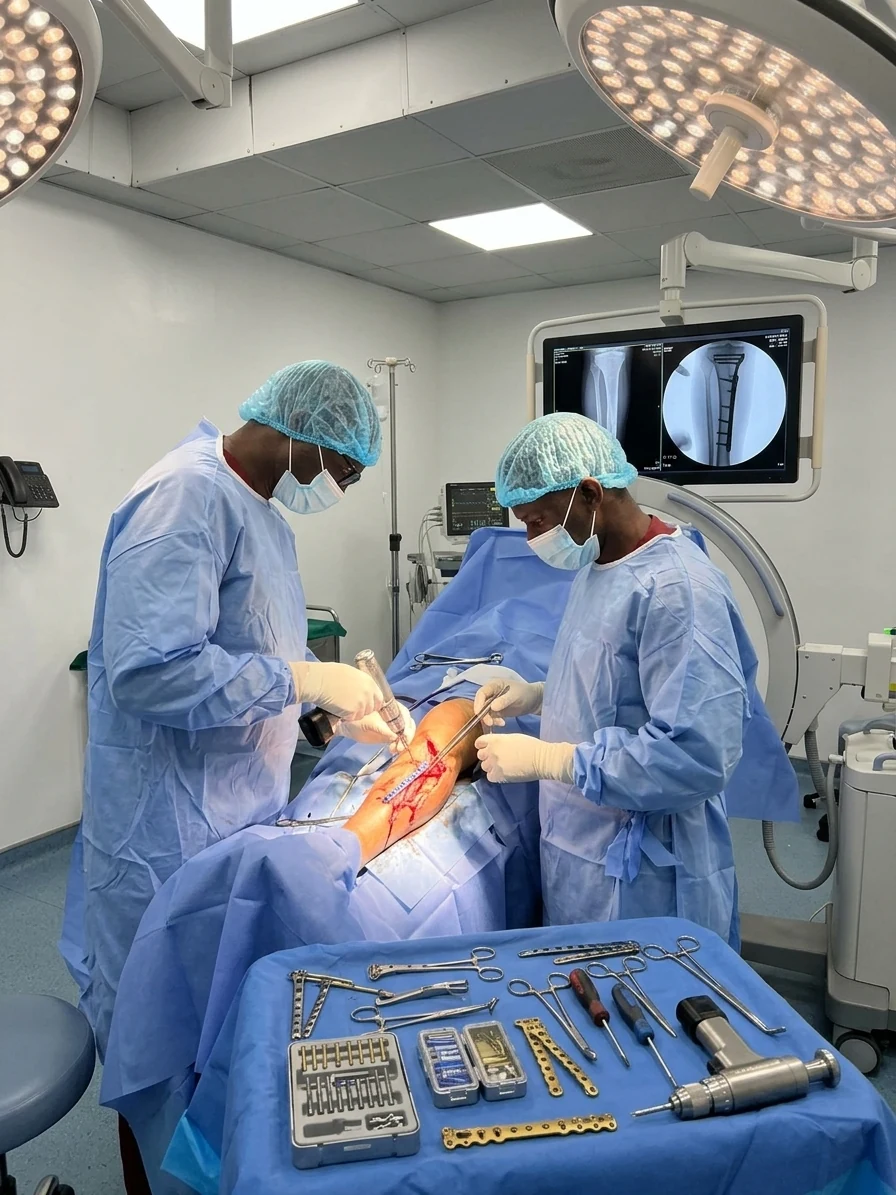
Assessment considers the mechanism of injury, pain, swelling, deformity, mobility, circulation, nerve function and appropriate diagnostic imaging.
The objective is to determine the nature and severity of the injury, identify associated problems and establish the most appropriate next step in treatment.
ASSESSMENT
Clinical evaluation helps establish the location, severity and functional effect of the trauma.
IMAGING
Appropriate imaging helps clarify fracture position, alignment, joint involvement and treatment requirements.
PLANNING
Treatment planning considers the injury, patient factors and expected functional recovery.
Not every fracture requires the same treatment.
Some injuries may be managed through immobilisation and observation, while others may require reduction, operative stabilisation or additional specialist intervention.
Selected fractures may be treated using splints, casts, braces or other forms of immobilisation with clinical review.
Displaced fractures may require manipulation or reduction to improve alignment before definitive treatment.
Internal or external fixation may be considered when fracture stability, alignment or healing requirements make surgery appropriate.
Clinical and imaging review help assess fracture healing, alignment, mobility and return of function.
Operative fracture treatment is considered when the characteristics of the injury, alignment, stability or patient circumstances indicate that surgical management may provide the more appropriate pathway.
ALIGNMENT
Fracture alignment and joint congruity are important considerations when determining the need for operative treatment.
STABILITY
Appropriate fixation may provide stability while bone and surrounding tissues progress through healing.
FUNCTION
The goal of treatment includes restoration of movement, independence and appropriate return to activity.
Successful fracture management does not end once the initial treatment has been completed.
Follow-up may involve wound review, repeat imaging, adjustment of immobilisation, rehabilitation, mobility progression and monitoring for complications while healing develops.
Clinical review and appropriate imaging help evaluate healing and alignment over time.
Activity and weight-bearing are advanced according to the injury, treatment and stage of recovery.
Rehabilitation may support movement, muscle strength, coordination and confidence after injury.
NEED SPECIALIST GUIDANCE?